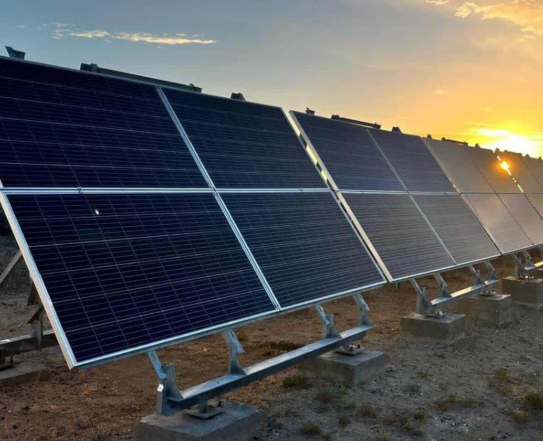

The growth in the installation of solar panel systems is saturating the electrical grid in Tamaulipas, acknowledged the Secretary of Energy Development, Walter Julián Ángel Jiménez.
“The problem is that solar panels provide a solution for some users, but especially those connected bidirectionally, they feed energy into the grid, and there comes a point where the energy supply is saturated in the substations and transformers,” he said.
How does solar energy affect the electrical grid in Tamaulipas?
He explained that the problem occurs at certain times of day, when the energy that these systems inject into the grid can saturate transformers and substations, creating risks for the stability of the electrical system.
He detailed that solar panels not only produce energy for the consumption of the user who installs them, since many of them are connected “bidirectionally,” meaning they can also send excess energy back to the general electrical grid.
The problem arises when many solar panels in the same area inject energy simultaneously, without sufficient demand to consume it.
This energy concentrates at the distribution “nodes,” the points where it connects to the grid, and begins to fluctuate, meaning it rises and falls uncontrollably.
“A reliability problem arises from the demand side,” the official explained, because the system cannot always disconnect or control this excess energy at the distribution points.
According to the secretary, this risk doesn’t occur at any time of day. In Tamaulipas, the most critical window is between 11:00 a.m. and 2:00 p.m., when solar generation is at its peak but energy consumption in homes and businesses is still low.
The situation changes in the afternoon, between 2:00 p.m. and 8:00 p.m., when electricity consumption is highest. The risk of saturation practically disappears because all that extra energy finds someone to use it.
To illustrate the risk, the official cited the case of Brazil, where the electricity regulatory body is already facing this problem in a real way. There is so much distributed solar generation that it cannot disconnect or control it at the distribution nodes, causing imbalances between electricity supply and demand.
According to the secretary, Tamaulipas has not yet reached that level of risk, but the problem begins to manifest itself when so-called “exempt generation”—that is, solar energy that does not require special procedures to connect to the grid—exceeds 5 megawatts in a single area.
To avoid reaching that point, the National Energy Commission (CNE) decided to reduce the threshold for exempt generation from 5 to 0.7 megawatts; in other words, it lowered the amount of solar energy that can be connected without additional controls.
The secretary described this measure as a smart decision, as it seeks to prevent an “abrupt growth” in solar panels that could create uncontrollable conditions at energy distribution nodes in the future.
With this adjustment, the energy authority aims to ensure that the installation of solar panels in Tamaulipas continues to grow in an orderly manner, without jeopardizing the stability of the electricity supply for other users.

Source: elmanana