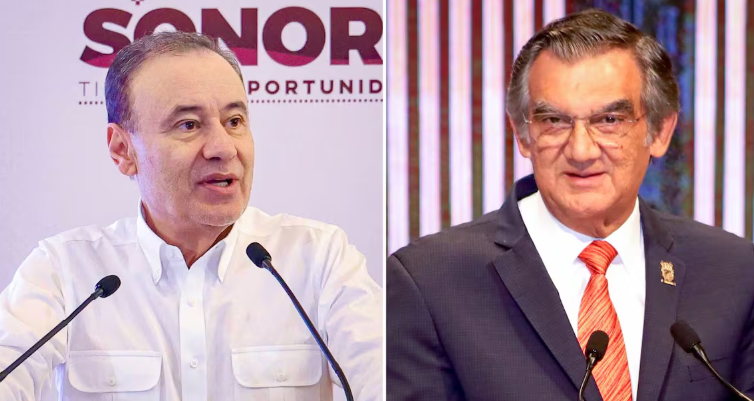

The U.S. government has revoked the visas of the MORENA governors of Sonora, Alfonso Durazo, and of Tamaulipas, Américo Villarreal, according to an exclusive report by the Los Angeles Times and Puente News published this Wednesday, which cites various sources familiar with the cases. The same report states that both politicians allegedly entered the country under the protection of a “special authorization typically reserved for witnesses cooperating with law enforcement.” Durazo and Villarreal are currently under investigation for alleged ties to organized crime, according to the same article.
Durazo has downplayed the media report, asserting that it is “just another story—sourceless—like so many others circulating without any basis.” The Sonoran governor—who has refused to produce his visa to refute the report—has also denied having any ties to organized crime. “In our community, everyone knows everyone else, and we all know everything about one another. If there were even the slightest hint of corruption—the slightest complicity—you would have been the first to find out,” the governor assured the media. Gerardo Algarín, the Director of Communications for the Tamaulipas government, also issued a “categorical and emphatic” denial of the report: “There are no documents, case files, rulings, or verifiable evidence to substantiate what has been published.”
On Wednesday, Sheinbaum indicated that the governors “must clarify” the information, while also expressing her displeasure regarding the leak. “What could be the motive behind revoking their visas… and, furthermore, making it public?! […] When one is at peace—secure in the knowledge of what one is doing, and with the assurance that we are acting for the good of the Mexican people and the nation—such things may arise. We all have the right, at the very least, to reserve judgment,” she stated during her morning press conference. These investigations represent a fresh setback for her administration, which has been embroiled in allegations since late April, when U.S. authorities indicted 10 other officials from Sinaloa for ties to organized crime. Among them is the governor of Sinaloa, Rubén Rocha Moya, who is currently on leave. The accusations brought by a New York prosecutor against the other 10 officials from the MORENA party sparked deep indignation within the Mexican Executive branch, which has maintained that the allegations are not supported by concrete evidence. In the days following the public disclosure of the cases, Rocha Moya requested a leave of absence from his post to undergo an investigation by the Attorney General’s Office (FGR); subsequently, two of the accused turned themselves in to U.S. authorities.
The so-called “Rocha case”—combined with the scandal surrounding the involvement of Central Intelligence Agency (CIA) agents in an operation in Chihuahua, as well as economic instability—has taken a toll on the President’s popularity. Now, a year and a half into her term, Sheinbaum is navigating her most delicate moment at the helm of the Executive branch. Nevertheless, despite this situation, she continues to enjoy high approval ratings, standing at 68% according to an Enkoll poll conducted for EL PAÍS and W Radio.
Mexico and the United States have been locked in a constant diplomatic spat since Donald Trump’s return to the White House early last year. In several of his speeches, the Republican has reiterated his claim that his southern neighbor is under the control of drug cartels—a stance that has clashed with the repeated denials issued by Sheinbaum’s administration, which has cited statistics showing a decline in homicides and highlighted high-profile arrests in an effort to smooth over tensions.
This battle against organized crime—a top priority for the Republican administration—has prompted the Trump administration to seek new levers of pressure, including the revocation of visas. By December of last year, at least 50 Mexican officials spanning the entire political spectrum had their visas revoked. These individuals include prominent figures such as the MORENA Governor of Baja California, María del Pilar Ávila, and the former PRI Governor of Guerrero, Héctor Astudillo (2015–2021).
Source: elpais